Addiction Recovery Programs at Sierra Tucson
1-800-842-4487
ABOUT USTOURPROGRAMSTHERAPIESPROFESSIONAL RESOURCESALUMNI RESOURCESEVENTSSTORE
PhilosophyAddictions/CoexistingTraumaEating DisordersMood DisordersPainProgressionsFamilyAssessment

Individualized Pain Management Services
Sierra Tucson Implements the Addiction-Free Pain Management® System
Expert Pain Diagnosis
Individualized Treatment Planning
Pain and Addiction
Treatment Outcomes
Who is Appropriate for the Pain Management Program?
Seven Point Clinical Philosophy of Pain Management
Sierra Tucson's Pain Specialists and Staff


Pain Management Program

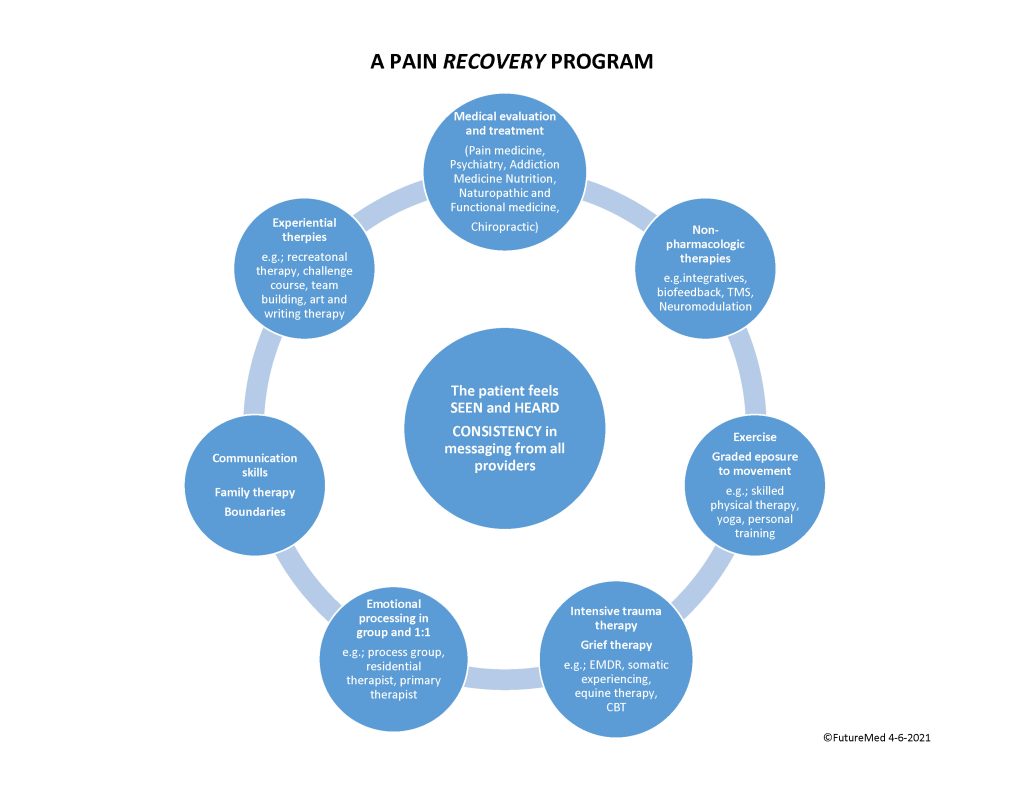
Sierra Tucson offers an innovative and comprehensive mind-body approach for the treatment of chronic pain. Chronic pain is complex in its causes and affects all parts of the body; it involves the tissues, bodily systems, and the mind.

Because chronic pain is multidimensional, it is never adequately addressed with a unidimensional treatment. Pain management must extend beyond physical approaches to include the psychological, social, and even spiritual aspects of the patient. Effective integrated treatment fosters self-awareness and teaches appropriate and effective self-care. In time, complex issues are managed, pain is reduced, and the patient moves toward peak physical and psychological functioning. Sierra Tucson offers an innovative and comprehensive mind-body approach for the treatment of chronic pain. Chronic pain is complex in its causes and affects all parts of the body; it involves the tissues, bodily systems, and the mind.

 Top

Individualized Pain Management Services

Since every person’s pain management needs are different, Sierra Tucson incorporates a broad approach to treatment that addresses the various concurrent bio-psycho-social-spiritual factors that contribute to chronic pain. The four components of the pain experience are: 1) the physical sensation, 2) automatic thoughts, 3) uncomfortable emotional reactions, and 4) the self-defeating behaviors that often result from the thinking and feelings. Studies show that as pain lingers on and becomes chronic, a patient’s mood and motivation are affected (Walker, Holloway & Sofaer, 1999; Jensen, Turner, Romano & Karoly, 1991). As patients learn to separate the physical sensations from their psycho-emotional responses, stress levels associated with the pain symptoms are reduced..

Every Chronic Pain Patient Wants to Know:
  1. What is wrong? (Diagnosis)
  2. What is going to happen to me? (Prognosis)
  3. What can be done? (Treatment Options)
Research tells us that patients who get answers to these questions have increased satisfaction, better coping strategies, and less anxiety. Understanding pain reduces the threat value and improves pain and outcomes.
~Moseley, Hodges, and Nicholas, 2003

Patients with Coexisting Addictive Disorders Also Want to Know:
  1. How am I going to function or manage my pain without my old medication?
  2. How will Sierra Tucson help me develop an ongoing recovery plan?
These questions and many more will be addressed by the Sierra Tucson treatment team while they work together with patients to develop safe and effective pain management plans. During the first week in treatment, patients also begin developing collaborative discharge treatment plans, which are finalized before they leave Sierra Tucson.

Please review Sierra Tucson's Clinical Philosophy of Pain Management.

 Top

Sierra Tucson Implements the Addiction-Free Pain Management® System

Sierra Tucson is the first facility in the United States to obtain the Addiction-Free Pain Management® (APM®) Center of Excellence designation. The APM® Center of Excellence process was developed by Dr. Stephen F. Grinstead* in collaboration with Terence T. Gorski and the Gorski-CENAPS® Corporation. This designation is reserved for those treatment providers who have demonstrated skilled pain management and addiction treatment services through the use of the Addiction-Free Pain Management® System and the Gorski-CENAPS® Model of Treatment. Although any provider may seek this designation, they must meet the rigorous standards for endorsement to be officially recognized. Sierra Tucson’s Pain Management Program has been provided with a complete set of APM® clinical manuals and accompanying treatment plans that are customized for their use.
Four Components of the APM® System
Utilized at Sierra Tucson
  • An in-depth comprehensive multidisciplinary bio-psycho-social-spiritual assessment process. 
  • An effective medication management plan that utilizes the services of board-certified pain specialists and certified addiction medicine specialists or practitioners. 
  • Cognitive-Behavioral and Dialectical Behavior Therapy interventions that utilize manualized treatment protocols. Some of these are developed by Dr. Mark Pirtle and others by Dr. Stephen Grinstead, and both sets are implemented by the clinical team.
  • Non-pharmacological treatment interventions such as hydrotherapy, physical therapy, EMDR, meditation, acupuncture, chiropractic, spiritual activities, meditation, and equine-assisted therapy, to name just a few, depending upon the needs of the patient.

*Dr. Stephen F. Grinstead, LMFT, ACRPS, CADC-II, is an author and internationally recognized expert in preventing relapse related to chronic pain disorders. He developed the Addiction-Free Pain Management® System, which gives clinicians specific tools and evidence-based manualized treatment to support them and patients seeking their help. You may learn more about Dr. Grinstead and Addiction-Free Pain Management® at www.addiction-free.com.

 Top

Expert Pain Diagnosis

Patients experiencing chronic pain receive a musculoskeletal and neurological exam from Sierra Tucson’s expert multidisciplinary pain specialists to determine if the pain originates from specific tissues, if it is being impacted by psychological features, or if it stems from a systemic condition. Chronic pain may be caused by a combination of physical, psycho-emotional, chemical, nutritional, behavioral, and/or environmental factors. Once the causes are fully understood, the patient receives both medical and psychological interventions and is guided into behavioral, lifestyle, and emotional changes that can help decrease pain over time.

 Top

Individualized Treatment Planning

A comprehensive and individualized treatment plan is developed for each patient, which may include some or many of the following services:

  • Musculoskeletal & Neurological Exam
  • Medical Consultations & Care
  • Skilled Nursing
  • Physical Therapy
  • Psychological Evaluation
  • Pharmacological Evaluation & Treatment
  • Awareness-Based Sensory Integration (ABSI)
  • Dialectical Behavior Therapy (DBT)
  • Experiential Therapy
  • Equine-Assisted Therapy
  • Substance Abuse Counseling
  • Trigger Point Therapy
  • Acupuncture
  • Safe Exercise & Movement Therapies
  • Pool & Hydrotherapy
  • Sleep Restoration Plan
  • Anti-inflammatory Nutrition Instruction
  • Manual Therapies: Massage, Mobilization, Manipulation
  • Other Integrative Therapies, as indicated
  • Pain Flare-up Planning
  • Relapse Prevention and Denial Management Counseling
Awareness-Based Sensory Integration (ABSI)
Sierra Tucson utilizes Awareness-Based Sensory Integration (ABSI) as a key approach in breaking the cycle of pain and psycho-emotional reactions. This specific mindfulness technique teaches patients to break down their subjective experience into identifiable parts, making individual sensations less likely to become overwhelming and allowing them to be experienced differently. Additionally, ABSI teaches vital skills and empowers individuals to deal with difficulties in all aspects of their lives.

Sleep Restoration
Sleep disorders are the most common health problem in the United States. So important is nightly regenerative sleep that many other health issues can stem directly from a lack thereof, including depression and chronic pain. It has been reported that pain sensitivity increases after only one night of poor sleep, so it is easy to see why sleep disorders are especially prevalent in pain patients. Patients in Sierra Tucson's Pain Management Program are carefully evaluated for a broad range of sleep-health risk factors, and recommendations are given to address these problems as part of their treatment.

 Top

Pain and Addiction

Addiction to pain medication is a common diagnosis and focus of treatment at Sierra Tucson. Physical pain, if not well managed, often acts as a primary trigger for addictive processes. The interdependence of pain management and addiction requires a high level of medical expertise to generate consistently successful outcomes. Sierra Tucson utilizes various proven therapeutic modalities, including the Addiction-Free Pain Management® System, to target the causes of pain. Thus, the patient receives the most comprehensive treatment available. Treatment seeks to use the fewest medications possible, and abstinence is always preferred. If medication is required, non-addictive medications with fewer side effects are considered first. Occasionally, opiates may be indicated for effective pain management and if so, an effective individualized medication management plan is developed.

 Top

Treatment Outcomes

Although no one is guaranteed to leave treatment pain-free, suffering can be relieved when patients implement the new skills they develop during the treatment process. As awareness, mood, sleep, and physical ability improve, the patient’s quality of life increases and continues to progress after treatment. Patients eventually reach the ultimate goal of long-term pain reduction and effective pain management through physical adaptation, cognitive-behavioral modification, and reconciliation of emotional conflicts. Sierra Tucson’s Pain Management Program provides patients with the self-care tools to manage, control, and reduce their pain, thereby improving their ability to function at high levels and, in essence, to take back their lives.

 Top

Who is Appropriate for the Pain Management Program?

Sierra Tucson’s comprehensive Pain Management Program, which is typically 45 days, successfully treats patients with short-term or long-standing pain. Patients who admit into another Sierra Tucson program may also receive Pain Management services. Chronic pain includes many painful disorders of the neck and back, headaches, neuropathies, oro-facial and arthritic pain, central nervous system sensitivity, and other musculoskeletal and rheumatic conditions, including fibromyalgia. In many cases, cancer-related pain may also be abated with a holistic approach.  Those requiring ongoing advanced pain procedures such as spinal cord stimulator implantation or morphine pump may be considered for treatment on a case-by-case basis. Patients who suffer from moderate chronic pain are helped to significantly reduce their pain and gain important skills for optimal living.

 Top

Seven Point Clinical Philosophy of Pain Management
  1. We believe that each patient’s report of pain is valid. Our approach to assisting the patient is driven by this basic assumption.
  2. We treat each patient with dignity, acknowledging their perception of pain and accepting their cultural, spiritual, and psychological values as their reality.
  3. Our primary goal is to assist the patient in wisely and skillfully managing their pain experiences, based upon the patient’s stated desire for pain relief.
  4. Given the nature of our facility—working with patients addicted to mood- altering chemicals—addressing both patients’ pain and their addiction becomes a delicate balance. We will, therefore, work to complete a comprehensive pain assessment with reassessment at regular intervals, taking into account the patient’s progress. This can only be accomplished using a multidisciplinary team approach.
  5. Pain will be a component of the patient’s interdisciplinary treatment plan. We educate all clinicians to assure competence in dealing with the addicted patient, whose treatment is complicated by coexisting  pain issues.
  6. Our role is that of advocate for the patient to assist in achieving his/her recovery goal while providing relief from pain.
  7. We have a committee for ongoing examination of our work in treating patients with acute and/or chronic pain. If we determine that we are unable to adequately and safely treat a patient with co-occurring pain issues, we will offer resources to the patient that may better address his/her pain needs.

 Top

Sierra Tucson's Pain Specialists and Staff

Sierra Tucson's pain specialists utilize the latest research in pain science to inform and direct the treatment of pain.

Steven R. Galper, M.D., J.D., M.B.A., Chief of Pain Medicine/Staff Psychiatrist Steven R. Galper, M.D., J.D., M.B.A.
Chief of Pain Medicine & Staff Psychiatrist

Dr. Steven Galper joined Sierra Tucson in July 2005 as a staff psychiatrist. He earned his medical degree from the University of Arizona, where he also completed a joint residency in Neurology and Psychiatry, as well as a  Pain Fellowship in the Department of Anesthesiology. Prior to beginning his medical education, he studied business at the University of Michigan and law at the University of Arizona, earning both M.B.A. and Juris Doctor degrees.  Dr. Galper uses psychologic, pharmacologic, and interventional modalities to treat recovering patients with acute and chronic pain at Sierra Tucson. The goal of treatment is to provide patients with multiple modalities to minimize and control their pain. Dr. Galper continues to lecture on scientific and educational topics regarding the impact of pain and its treatment on recovery, and he has several peer-reviewed publications to his credit.

Mark Farris Pirtle, D.P.T., CSCS, COMT, Associate Director of Pain Management Program Mark Farris Pirtle, D.P.T., CSCS, COMT
Associate Director of Pain Management Program

Dr. Mark Pirtle completed his Doctor of Physical Therapy degree (with Distinction) at Northern Arizona University and also holds bachelor’s degrees in Physical Therapy and Political Science. He serves as faculty for Dr. Andrew Weil’s Integrative Medicine Fellowship Program at the University of Arizona and for the International Spine and Pain Institute, and he has taught “Integral Recovery” to guests at Miraval, Life in Balance® resort in Catalina, Arizona. He is President of Pathways Technologies, a company that is testing software designed to diagnose 27 different types of conditions that cause low back and/or leg pain. Dr. Pirtle co-authored Adaptive Medical Knowledge Management: An Integrated Rule-Based and Bayesian Network Approach with Lin et al., in 2004 and is currently writing a book for the lay public about the causes and remedies of chronic back pain called “The End of Back Pain.” Dr. Pirtle has trained extensively with the International Academy of Orthopedic Medicine – Europe, which emphasizes precision in clinical examination and treatment of neuro-orthopedic conditions. Through the IAOM-Eur, he became a Certified Orthopedic Manual Therapist (COMT). He has also been certified by the National Strength and Conditioning Association as a Strength and Conditioning Specialist (CSCS). Dr. Pirtle’s client list includes professional athletes from all the major sports, Olympians, and world record holders.

Carol Power, R.N., M.S.N., Director of Nursing Carol Power, R.N., M.S.N.
Director of Nursing

Sierra Tucson’s Nursing Department has benefited from Carol Power’s excellent direction since September 2000. After receiving her bachelor of science degree in Nursing from the University of Arizona in 1972, she obtained her master of science in Nursing from University of Alabama in Birmingham in 1980.

Linda M. Hampton, M.A., LPC, LISAC, Unit Therapist, Pain Management Program Linda M. Hampton, M.A., LPC, LISAC
Unit Therapist, Pain Management Program

In September 2005, Linda Hampton joined Sierra Tucson as Unit Therapist in the Mood and Anxiety Program. She facilitates therapeutic process for patients with a variety of mood disorders and chronic pain management issues. Formerly from New York City, Linda has lived in Tucson, Arizona, for over 20 years. She received her bachelor’s and master’s degrees from Prescott College in Psychological Counseling. A therapist since 1989, her professional background has included a private practice specializing in Ericksonian Hypnotherapy for patients with chronic pain, pre-operative readiness, post-operative pain, and end-of-life issues. Linda has participated in treatment teams for both inpatient and outpatient programs in management and therapist roles.

Brenda Baker, M.Ed., LISAC, CADAC, Unit Therapist, Pain Management Program Brenda Baker, M.Ed., LISAC, CADAC
Unit Therapist, Pain Management Program

Brenda Baker holds bachelor’s degrees in Business Administration and Accounting and a Master of Education in Counseling. She is a Licensed Independent Substance Abuse Counselor (LISAC) and a Certified Alcohol and Drug Abuse Counselor (CADAC). In addition to Brenda’s current role of unit therapist for the Pain Management Program, she has held a variety of positions at Sierra Tucson, including family therapist, float therapist, and unit therapist for Chemical Dependency and the Mood and Anxiety Program. Brenda’s professional experience is complemented by her personal recovery in Twelve-Step programs and recovery from long-term medical issues.

For more information, please call us anytime at 1-800-842-4487
or speak confidentially online with a caring staff member.
You may also contact us by e-mail to request more information.

 Top


Chemical Dependency | Alcoholism |  Eating Disorders |  Trauma/Abuse |  Sexual Compulsivity |  Depression |  Anxiety |  Pain Management |  Gambling
Home |  Contact Us |  Private Chat |  Self-Evaluation |  Event Registration |  CRC Health

Toll-free from U.S.A.: 1-800-842-4487
Freephone from U.K.: 0800 891166

© Copyright 2006 Sierra Tucson, Inc. - Since 1983, Sierra Tucson has grown from a drug rehab center to a comprehensive inpatient treatment facility. We help individuals and families overcome addiction and behavioral disorders and rebuild their lives. Recovery means a better way of life!